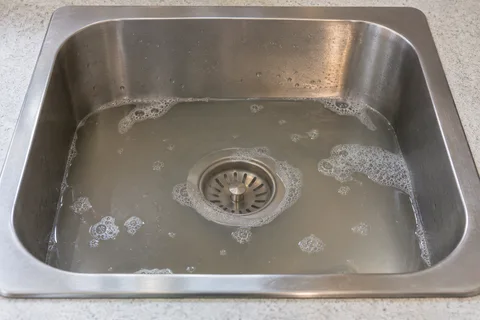
We investigate local drainage problems in sinks, baths, showers, toilets and appliance waste connections. Knowing which outlets are affected helps us work out where to start.
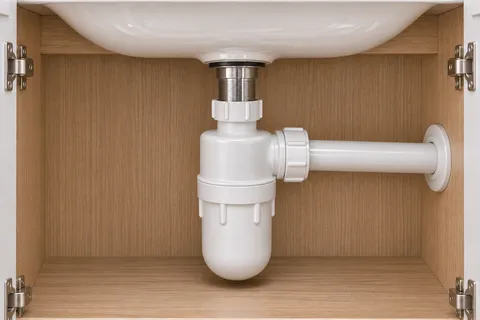
Example of a basin waste and bottle trap. Water leaves through the pipe at the side.
What happens when you empty the basin?
Tell us whether the plug opens, how quickly water drains and whether nearby fittings behave the same way.
The plug opens and water still sits in the bowl
Whether the water trickles away or stays in the bowl, we start at the waste fitting beneath the plughole and the trap underneath. If both are clear, we look further down the waste pipe.
We discuss manual or vacuum clearance according to the blockage and access, then check how the basin drains. If there is a smell, we also look for deposits in the waste and trap and check the trap’s water seal.
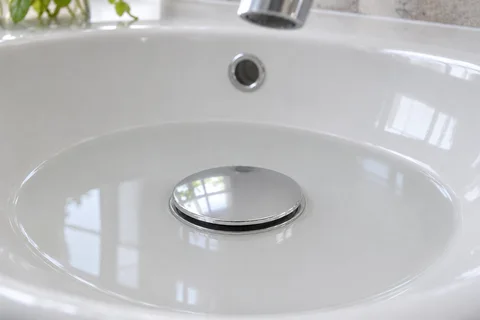
The push-button plug sticks or will not seal
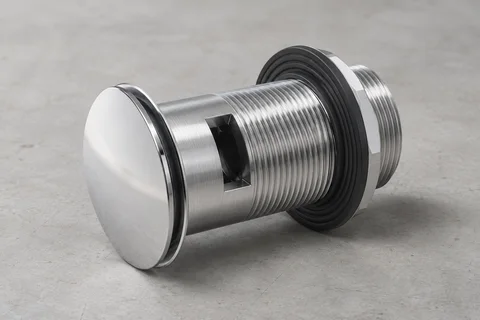
The cap and its spring mechanism close the plughole. If the waste body is sound and the part matches, a replacement plug or mechanism can restore it.
If the body is too worn or too clogged to clean economically, we discuss a new waste. We check whether the basin has an overflow and how the new fitting will join the trap.
If the bath or shower also drains slowly, or if one outlet backs up when another empties, the restriction may be where the waste pipes join.
Tell us which outlets are affected and whether an appliance was running. The pattern helps us decide whether to look at one fitting, an internal branch or shared drainage.
We start with the waste fitting at the plughole and the trap underneath. If both are clear, we check further along the waste pipe.
Water stays in the basin
Tell us whether the plug opens and whether any water drains away. A jammed plug can hold water in the bowl. With the plug open, standing water can indicate a complete blockage.
Two fittings affect each other
A basin gurgling when an appliance drains, or water appearing in a shower when a toilet is flushed, can point to a shared branch.
A toilet backs up
Stop flushing if water is rising. Tell us whether other outlets are affected and whether there has been an overflow.
Dirty water comes back when a washing machine empties
A sink and appliance may share part of the waste pipe. Tell us where water comes back up and which appliances were running.
There is a bad smell at the basin plughole
Build-up in the waste fitting or trap can smell. A trap holds water to keep drain smells out of the room. If the basin has been unused or the smell changes when another outlet drains, mention it so we can check the water seal and connections.
Water returns through the other bowl of a double sink
If it happens when you empty the first bowl, the restriction may be after the two wastes join. Tell us whether both bowls are affected and whether an appliance uses the same waste.
Which fitting is affected?
01Kitchen sink or utility waste
We start with the trap and accessible waste pipe. Knowing whether one or both bowls drain slowly helps narrow down where the restriction may be.
02Bathroom basin with a vanity or pedestal
Tell us if the trap sits behind a drawer or pedestal. We check what can be reached and explain any access needed before starting work.
03Bath or shower drains slowly
We check the accessible waste and trap. A shower that leaks through the ceiling only while draining may need a waste repair as well as, or instead of, clearing.
04Several outlets or an outside gully back up
Tell us whether neighbours are affected or an outside gully is overflowing. A shared or public sewer may need the wastewater company, and the symptoms can help decide whom to contact.
What we can do
We check the affected outlets and accessible waste pipework. For partial or complete blockages, we discuss manual or vacuum clearance according to the fitting and access. We check the flow afterwards. A shared or external drainage fault may need the responsible party or a specialist. Clearance addresses the blockage present at the time.
Parts we may check or replace
These are examples. We check what is fitted before choosing a replacement.
McAlpine TP10 1½-inch swivel trap
The trap beneath a sink holds water to keep drain smells out of the room. If its body or seal leaks, we check the waste size and outlet direction for a replacement. If the trap is sound and the blockage is further down, clearing the pipe is a separate job.
The clicker closes the plughole. The trap below keeps a water seal. We check which piece has failed and whether a compatible plug or mechanism can be fitted to the existing waste.
Tell us which fixtures are affected, when the problem started and whether drain chemicals have already been used. Avoid adding more chemicals while you wait.
Send your postcode, what is happening and a photo if it helps. Tell us if water is still escaping.
02
Agree the visit
We confirm availability and explain the basis of any attendance or investigation charge before booking.
03
Agree and check the work
We explain what we find, agree any further work and check the affected plumbing afterwards.
Common questions
Can you prevent a blockage from coming back?
That depends on the condition and layout of the existing waste pipes. We can discuss any defect we find and explain whether further investigation or work would help.
My toilet won’t flush. Is it blocked?
If the bowl drains normally, the fault may be with the cistern or flush controls. Tell us whether the cistern fills, whether water enters the bowl and whether it drains away.
Can you give me an estimate?
We discuss the work and the basis of any attendance or investigation charge before booking. Where the fault or access is uncertain, we may need to assess it first. We discuss any change to the agreed scope before additional work.